CASTEL SANDRA - AN ABANDONED HOTEL IN CILENTO, PHOTOGRAPHED OVER TEN YEARS
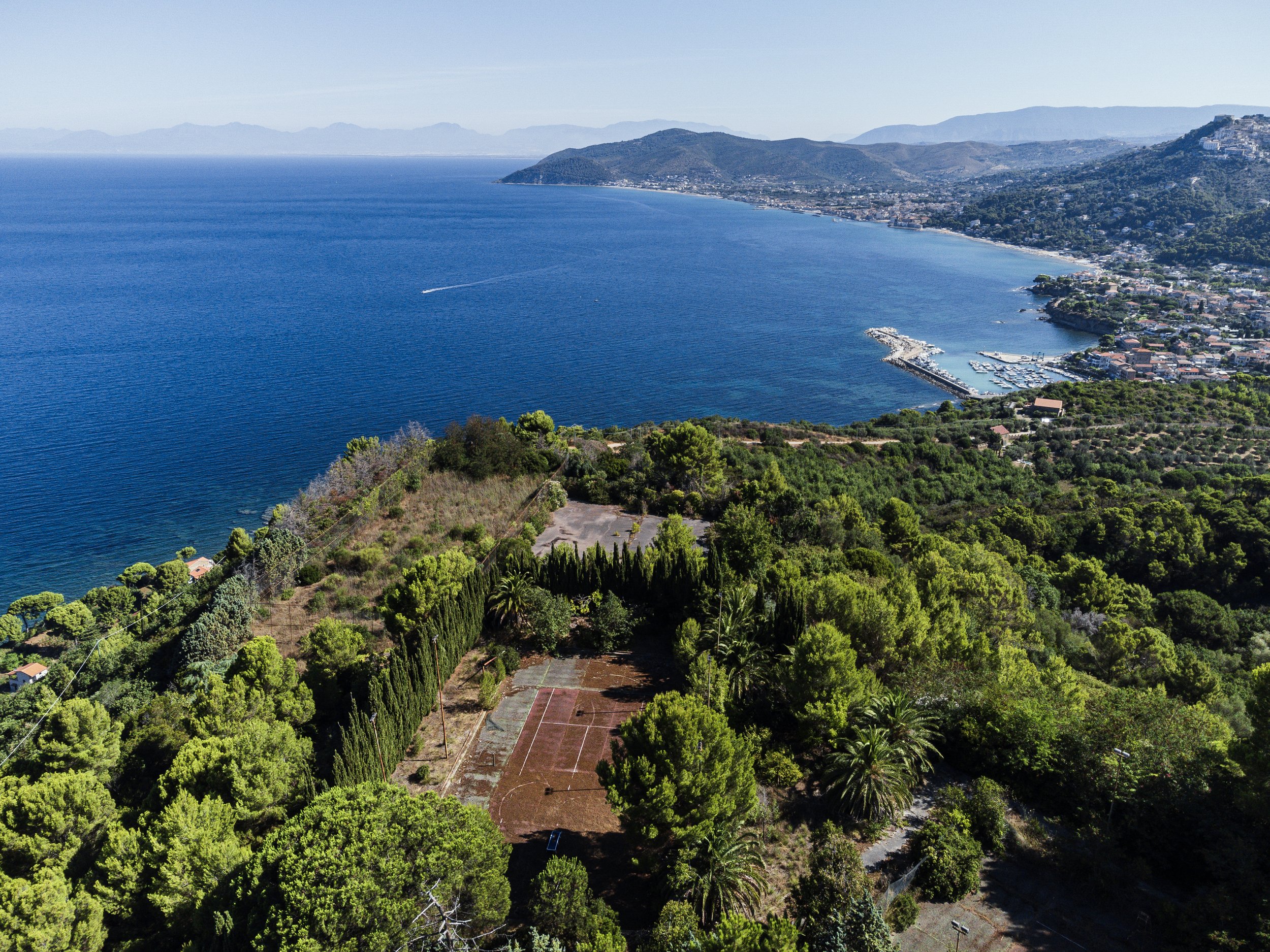
A personal essay on Castel Sandra, the abandoned luxury resort on the Cilento coast, and the summer of 2024 I spent photographing it before leaving Italy.Tennis court with a view on the bay (August 2022)
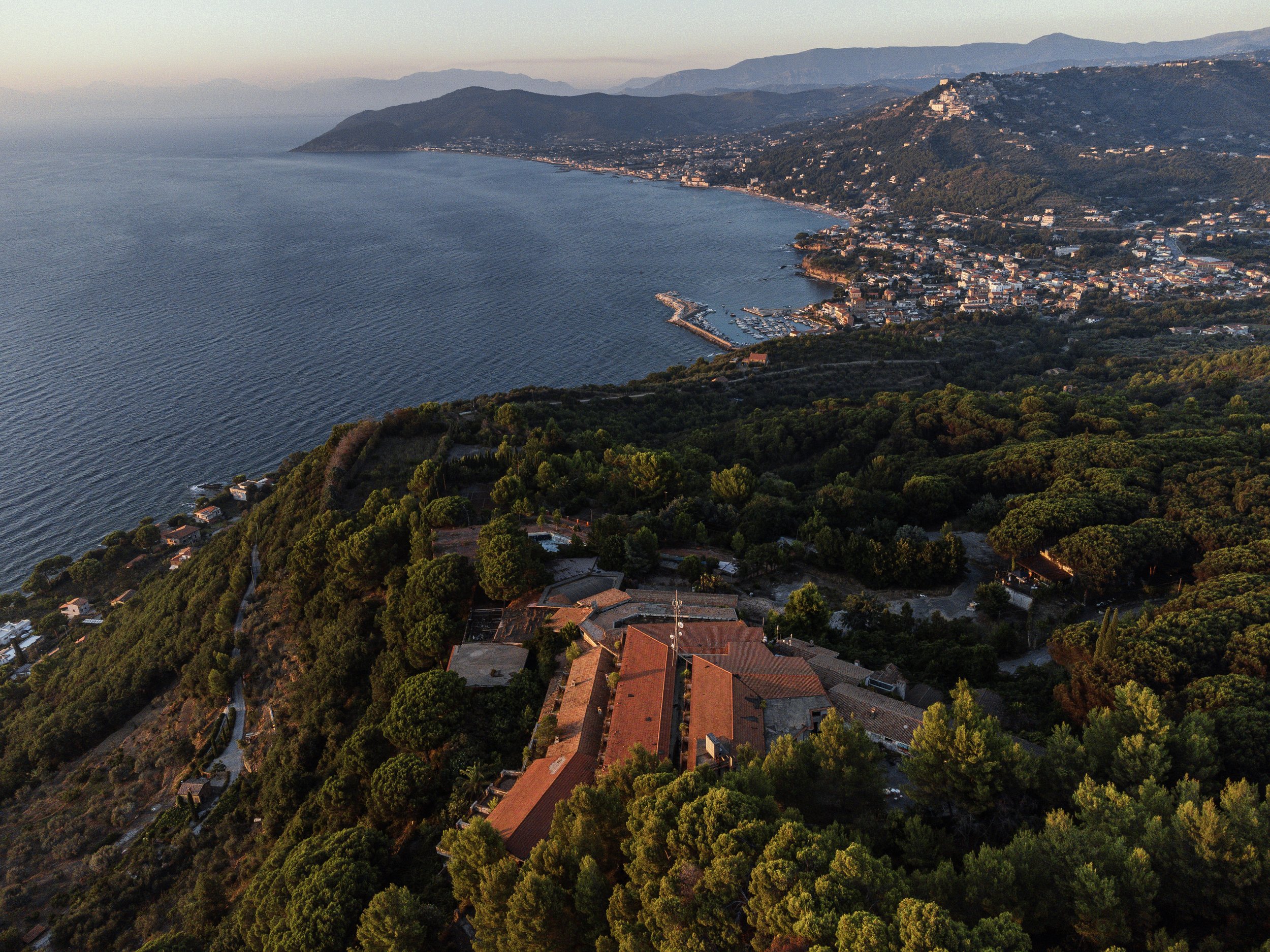
There is a terrace on the top of a mountain south of Salerno where I have been watching the sun set since 2015. The view from it covers most of the Cilento coast - the bay, the slow curve of the Amalfi coast in the distance, and on the very clearest days a smudge on the horizon that is Capri. Behind me, when I'm sitting there, is what used to be a hotel. More than two hundred and fifty rooms, three pools, two restaurants, a cinema, a theatre, three tennis courts, a football field, a ranch where guests rode horses, and - briefly, in the strangest period of the place's history - a zoo with lions and giraffes and hippopotamuses.

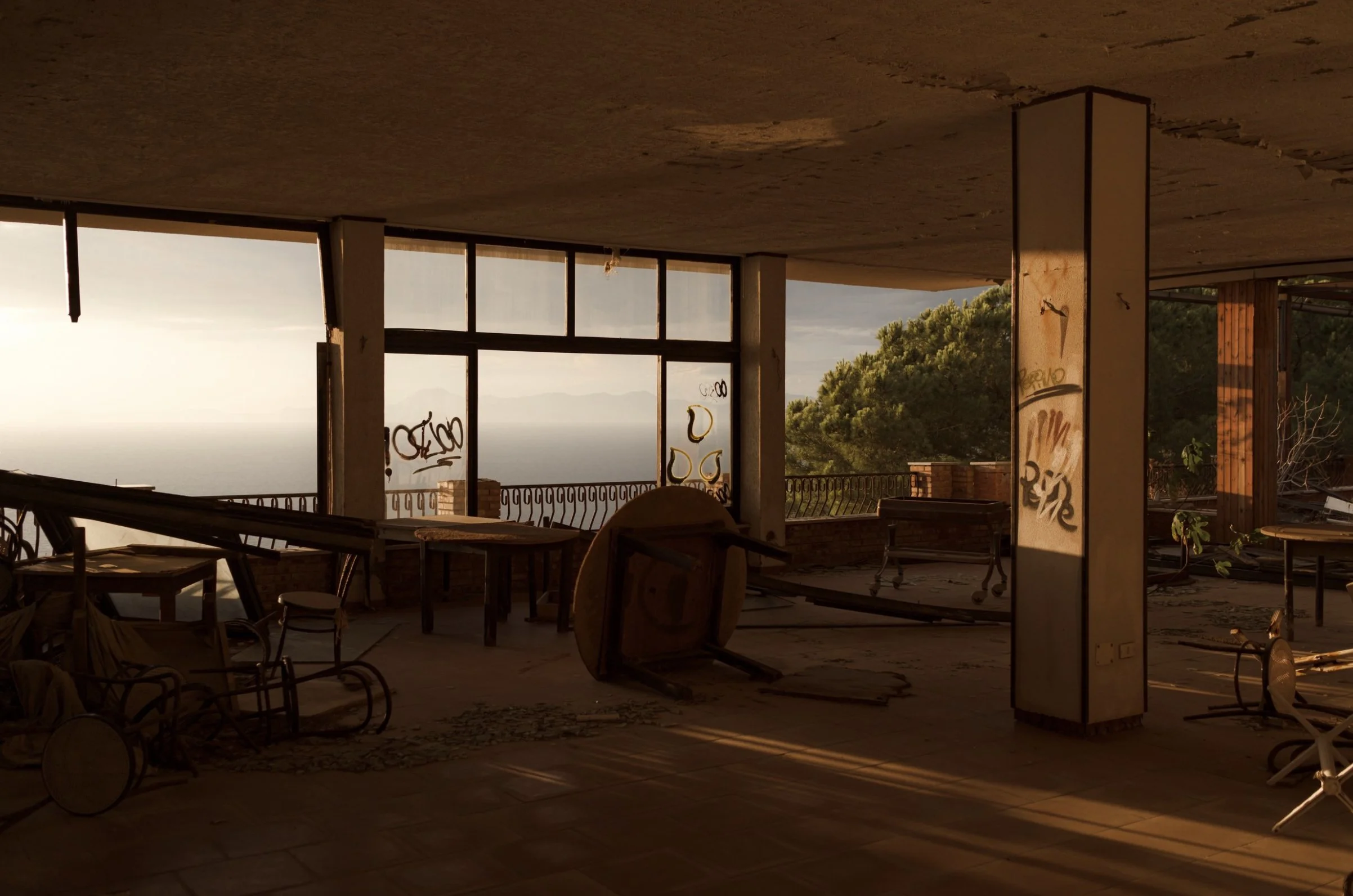
Nothing works anymore. The roof has been opening in slow motion for thirty years. The light still does what the light has always done.

This is Castel Sandra. It is the most extraordinary place I know in the world, and it has been my favorite spot since the first time I walked onto that terrace. In the summer of 2024, before 1 moved to Lisbon, I spent three months photographing it more carefully than I ever had. This is the story.The main property complex (July 2024)
A hotel built for a daughter
The hotel was commissioned in the late 1960s by a Belgian couple. They had recently lost their daughter - Sandra, hence the name - and the project, at its origin, was a kind of sanctuary built in her memory. The first version of Castel Sandra opened in the early 1970s as a modest seaside retreat on a piece of cliff with a view that, then as now, would stop any architect mid-sentence.
It didn't stay modest for long. By the end of the decade, a local Camorra clan had recognized what the property could be and acquired it out of the family's hands under circumstances I'll let history describe more accurately than I can.
What followed was a transformation of an order you almost can't believe when you stand in the ruins now. The resort was expanded into what was, briefly, one of the largest and most absurd hotels on the Italian Mediterranean. The two hundred and fifty-plus rooms, including the twenty-odd suites. The cinema and theatre I mentioned. The horse ranch. The pools cascading down the mountainside. And the zoo, which I keep wanting to put a question mark after when I write it, because even on the seventh time you read about it the existence of a private zoo with lions and giraffes in a hotel on the Cilento coast in the 1980s does not entirely settle into the part of your brain that handles real things. This phase lasted until 1995, when the property was confiscated by the Italian state in the larger sweep of anti-Camorra seizures of the early ‘90s. It has been the state's responsibility ever since, which means in practice it has been nobody's responsibility ever since. No buyer has come. No public function has been found.
The building has been left to do what buildings left alone in the Mediterranean do - to age slowly, to host birds and weather, to give up its corners one season at a time.
The resort overlooking the bay with parts of the Amalfi Coast in the far background (July 2024)
How I found it
My parents have a small house by the sea not far from there. I had passed the hotel's overgrown access road dozens of times as a teenager without paying it any attention. In the summer of 2015 - the same summer I bought my first camera, the Nikon D3400 l've written about elsewhere - I drove up the road one afternoon out of curiosity. I parked at the gate, walked past the abandoned sentry post, and within ten minutes I understood I had found something that was going to be a long-running relationship.
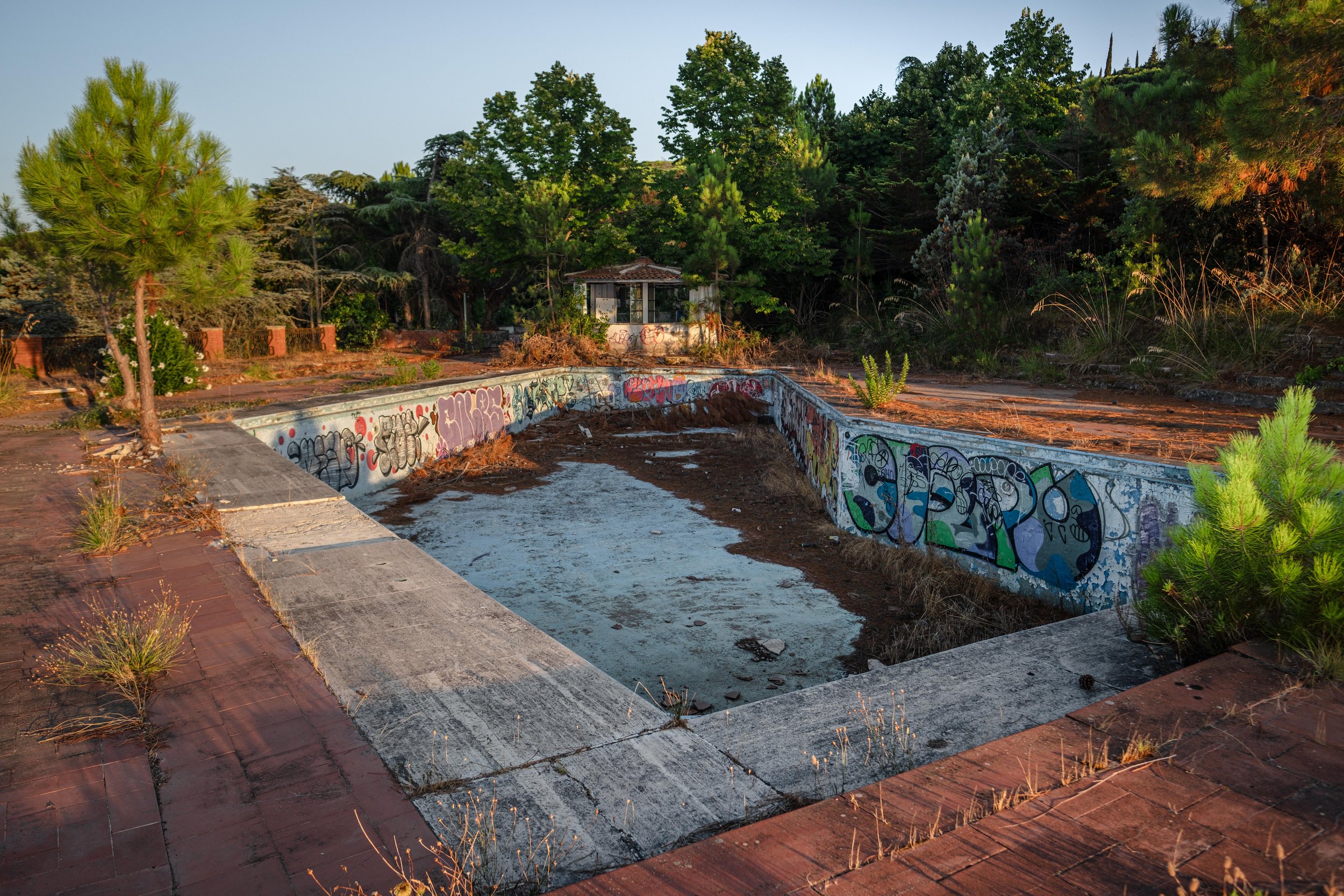
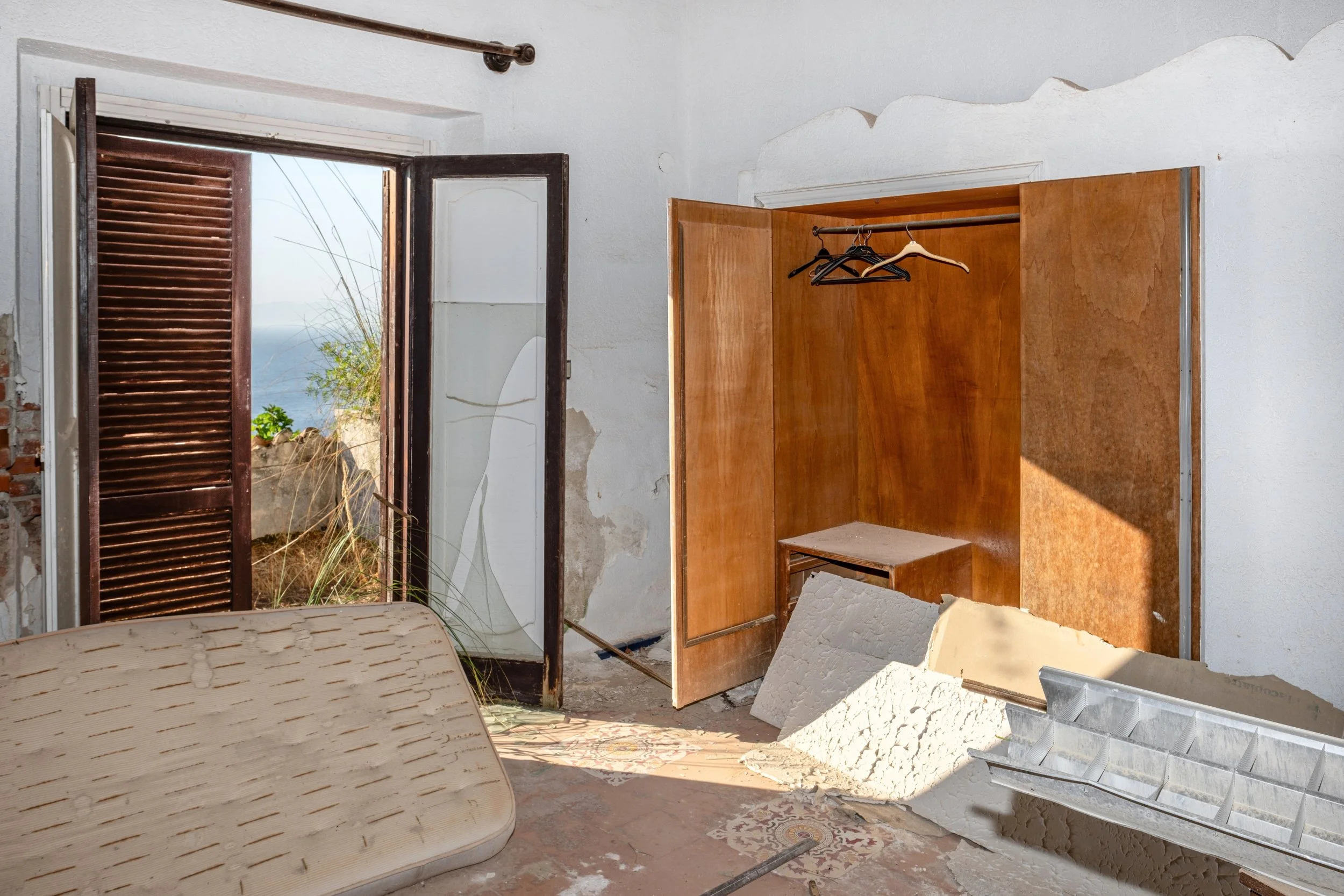
The scale did it first. You can read in three sentences that the resort had three pools and several hundred rooms; standing in it is a different operation. You walk for an hour and you haven't seen the same room twice. You climb to the top floor of one of the four-story residence wings and you can see the whole property from above - pools choked with rainwater and graffiti, the bones of the restaurant, the rectangle of the football field reclaimed by wild grass, the ranch buildings collapsing into their own shadows - and you realize you're looking at a city that someone tried to invent in the early 1980s and that nature has been quietly editing ever since.
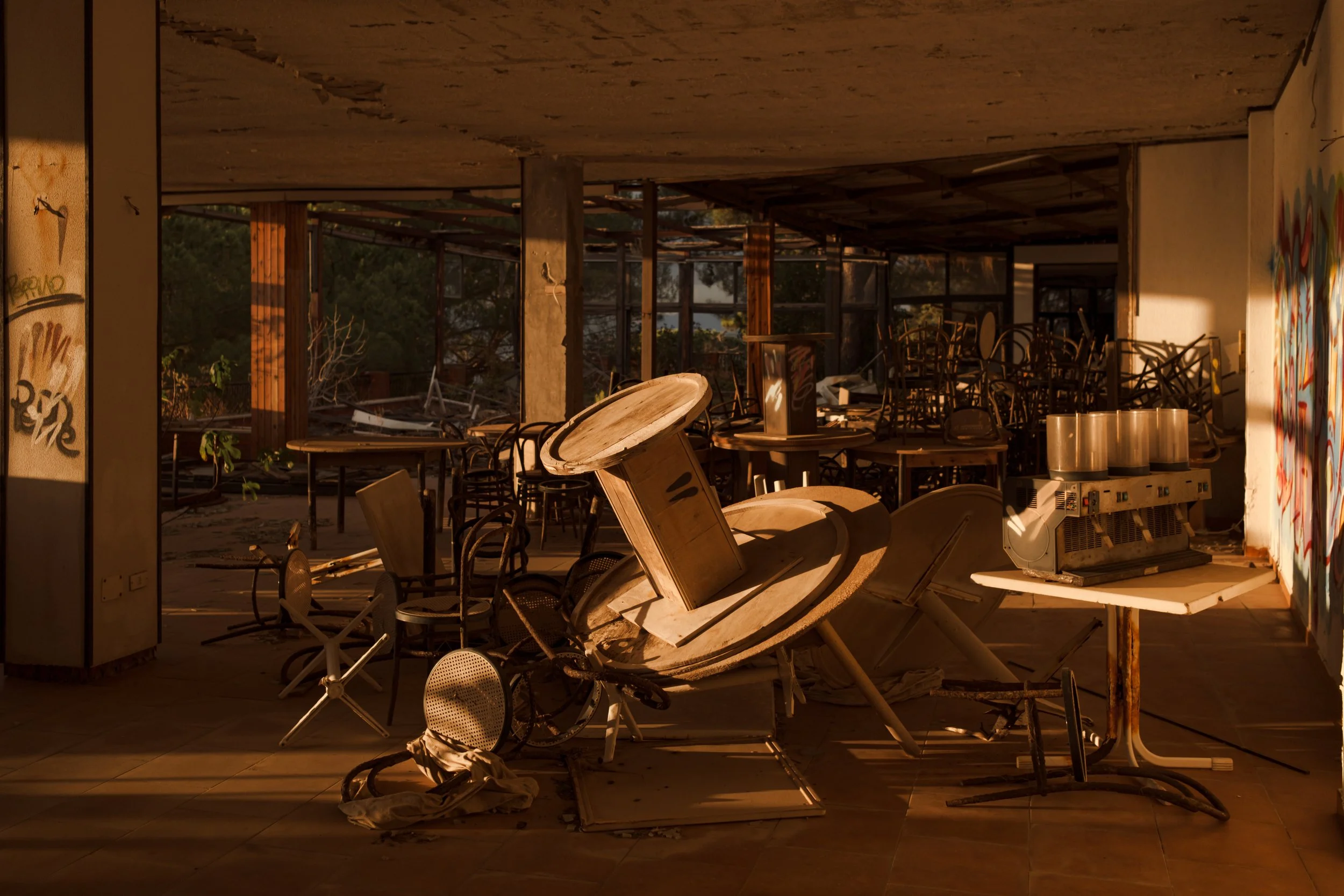
I went back the following summer. And the one after that. By 2018 I had developed a route through the building that I follow more or less every year: the lobby first, then the restaurant with the dust-covered chairs, then the kitchen with the espresso machine still sitting on the counter where someone left it, then up to the residence floors, then out to the terrace for the sunset. I've made the same loop in winter rain and in August heat. I know which staircases are safe and which ones I don't trust. I know which rooms have the strongest light at five o'clock.
Main pool and pool bar (August 2024)
What three months felt like
The summer of 2024 was the longest stretch I'd ever spent in Cilento as an adult. I had decided to leave Milan - a city I had grown to find suffocating - and the move to Lisbon was already in motion. Between the decision and the actual departure, I spent the whole summer at my parents' house. Most days I drove up to the hotel.
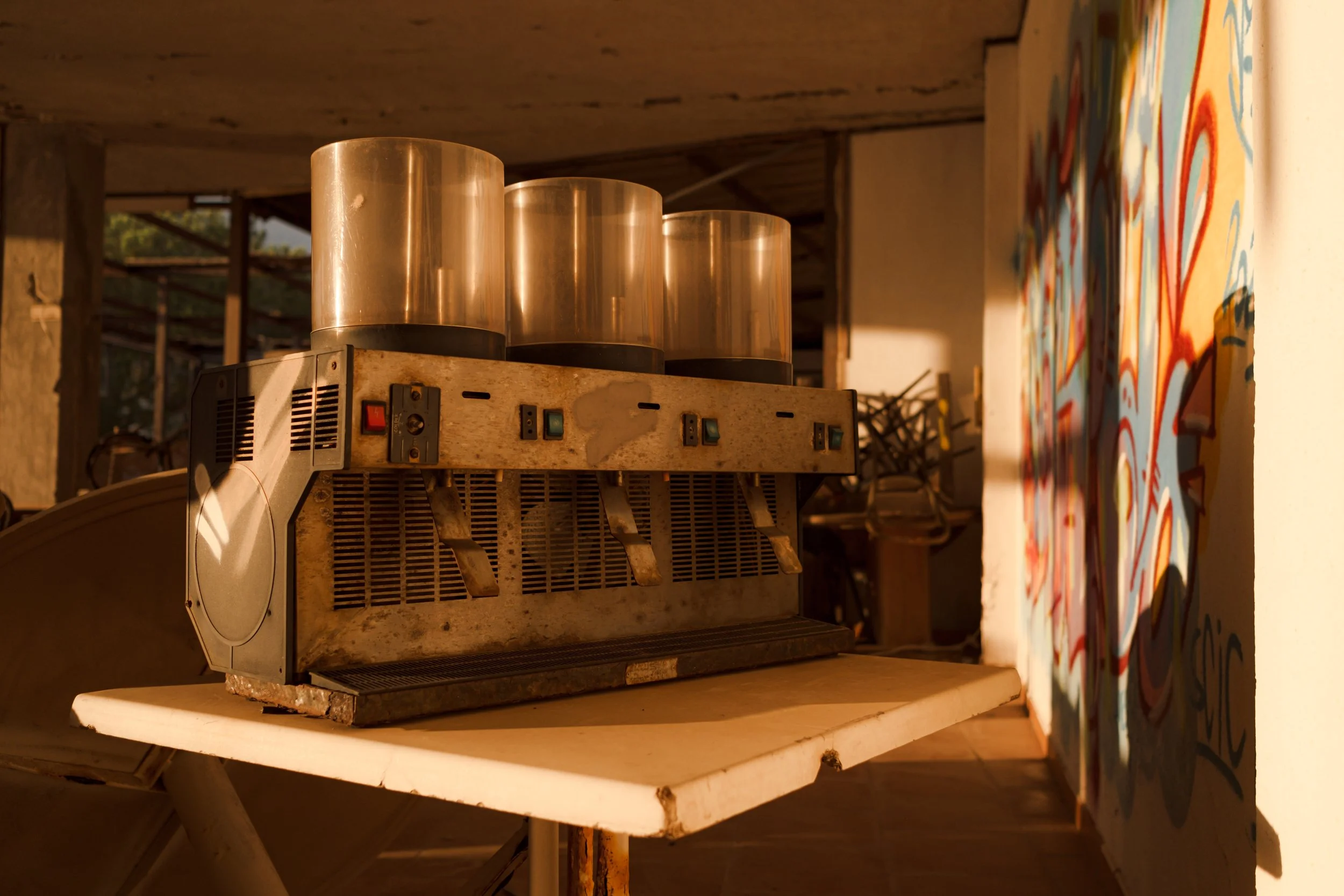
What I was doing wasn't strictly a project at first. I was visiting a friend. I would sit on the terrace for an hour, walk the loop, photograph whatever was different from the year before - a wall that had collapsed since my last visit, a piece of furniture that had migrated rooms, a new patch of graffiti, the same “granita” machine.
The “Granita” Machine (August 2021)
Slowly, across June and July, I started thinking of the summer as a deliberate documentation. I wasn't sure when I would be back. Lisbon was, at that point, an open-ended decision. The hotel was deteriorating faster every year. The math wasn't comforting.
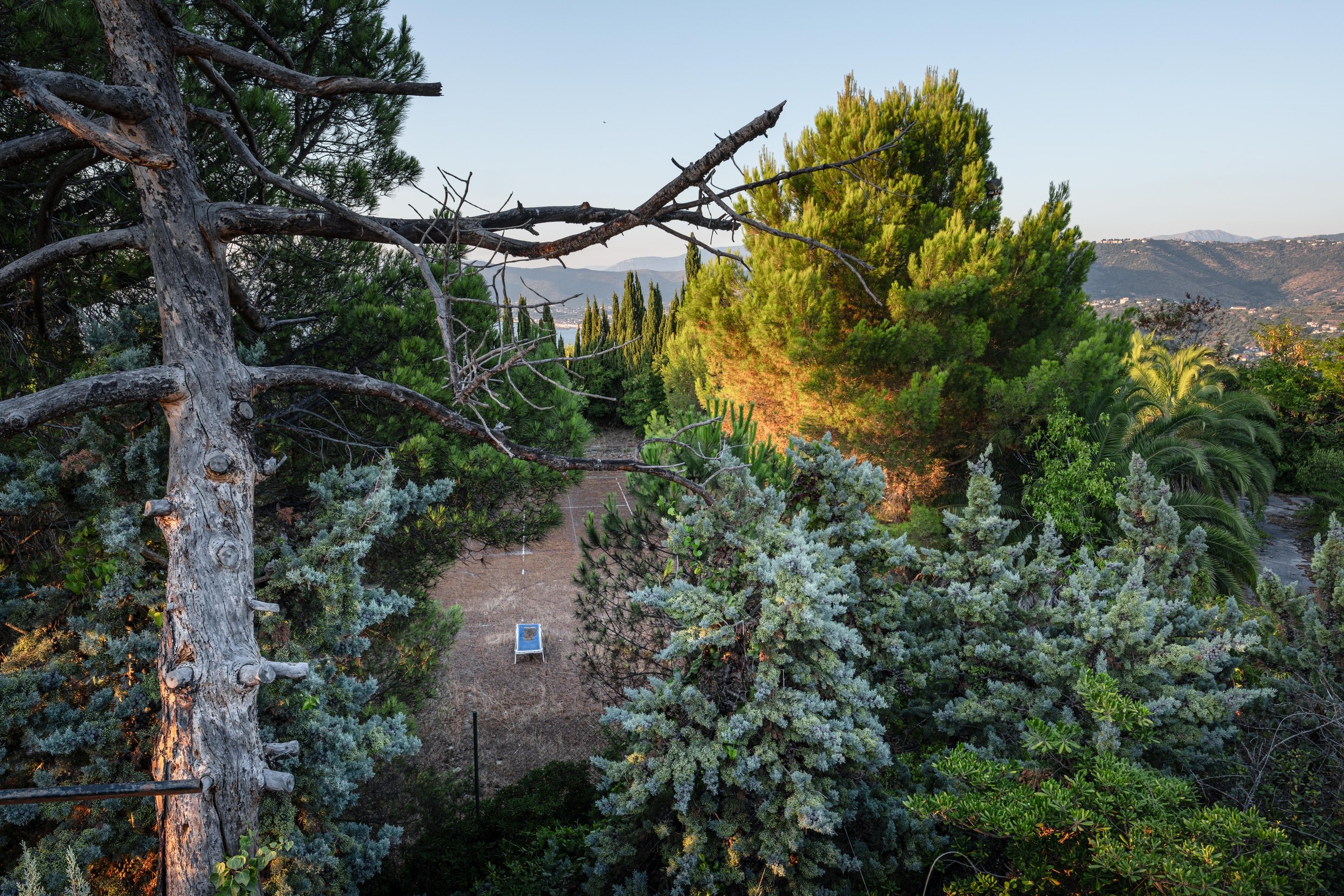
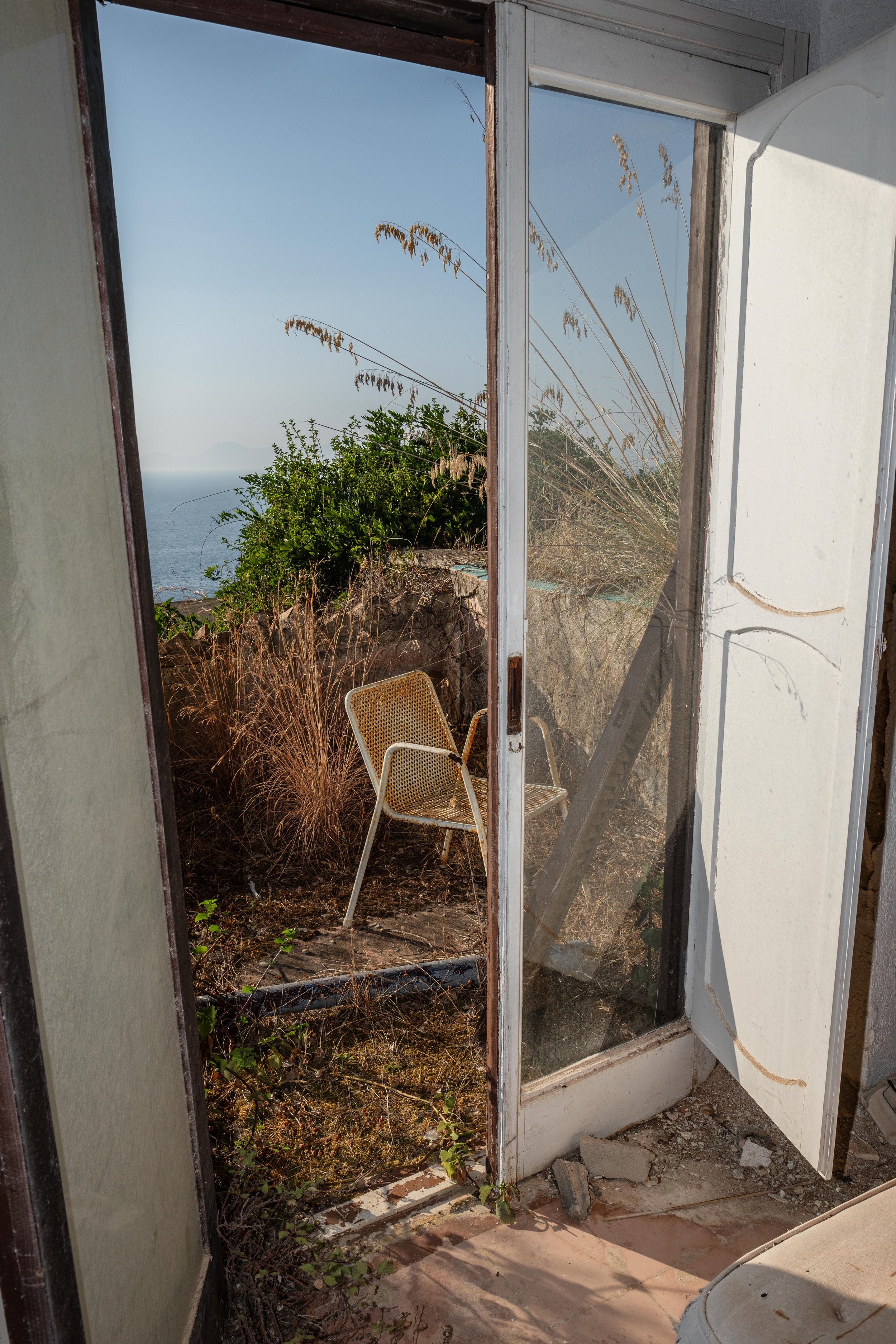
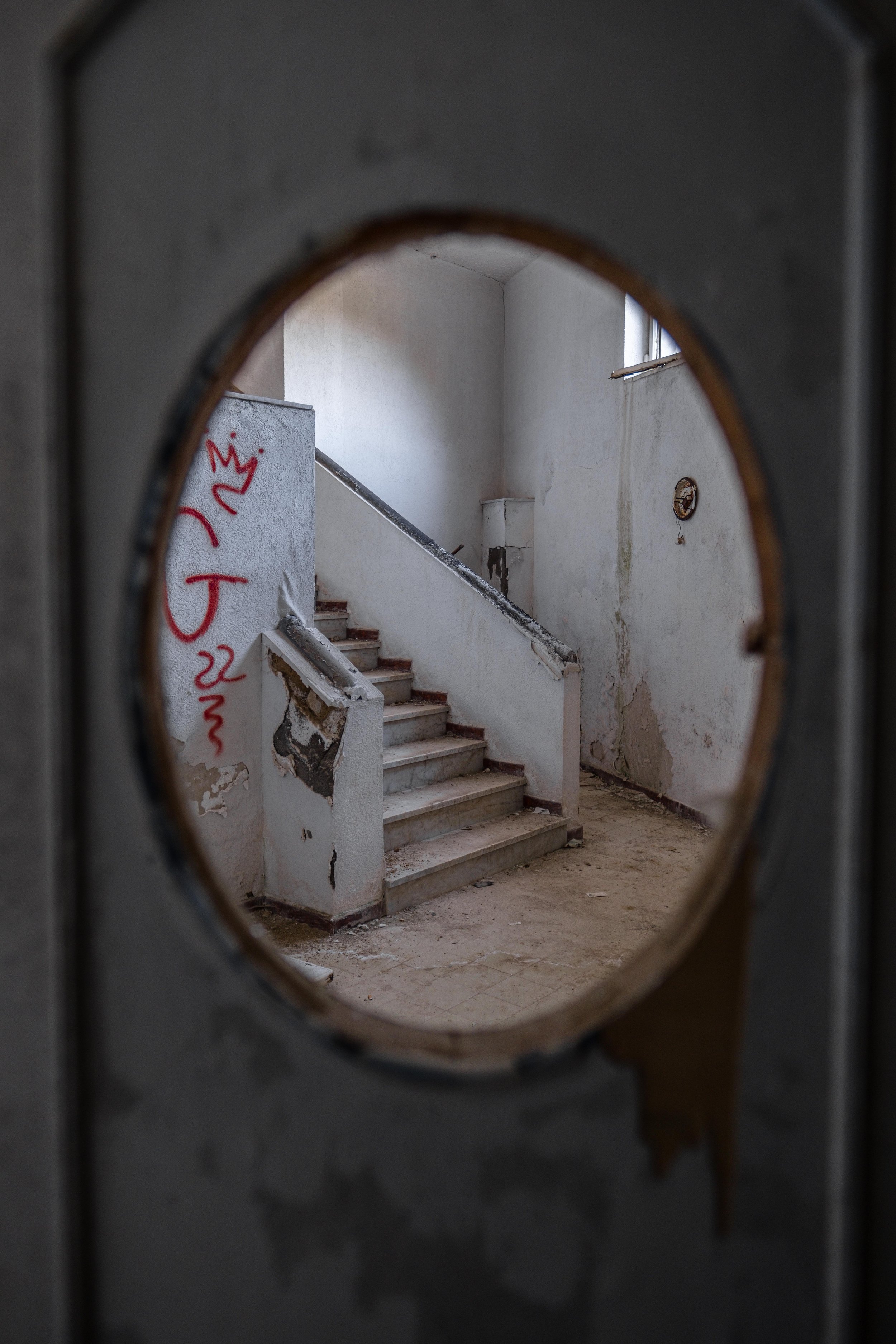
So I shot it properly. The interiors, the exteriors, the wide architectural drone passes that showed how the buildings sat in the landscape, the small details I had been seeing for years but had never bothered to photograph because they were always going to be there - the broken porthole window in the corridor that frames the staircase behind it, the lone sunbed left in the middle of a dry field, the chair on the terrace seen through the warped glass of a sliding door. I photographed the views from the suites I had always loved and the ones I had ignored. I flew the drone over the whole property from angles I had never bothered with. I was trying, without saying so out loud, to preserve the place for myself in case it was the last time.
I did one shoot that summer with two models and a fashion designer - the only proper portrait session I have ever organized at Castel Sandra, and probably the last. The rest of the time I was alone, mostly, with the camera and the wind and the sound of the cicadas, which at the end of July at that altitude is loud enough to be its own kind of weather.

What I’m afraid of
I am writing this piece knowing it might be a mistake.
The places I work in - abandoned villas, derelict palaces, forgotten interiors - get shorter lifespans the better-known they become. A building with a hundred geo-tagged photos on it has months left before it's been spray-painted, looted, or fenced off. Castel Sandra is already more visible than the locations I usually shoot in; it has a Wikipedia entry, it gets written up every couple of years in long-form travel pieces, and a small but persistent flow of urbex visitors come for the photographs and leave their tags on the pool walls. It is already on the slow path all places like this are on. Writing about it cannot make that path slower.
But I have wanted to write about it for years, and the summer of 2024 was the closest I have come to articulating what the place is to me. So this is the piece. I have left out the precise location even though anyone who wants to find it can find it in five minutes online. I have left out the names of the people who built it and the people who took it. I have used the photographs I think are the most honest and the least exploitable. I have not used any of the more dramatic frames have of the suites, because I want them to stay for me.
What I want to say is this. Castel Sandra is, for reasons I do not fully understand and have stopped trying to, the place I love most in the world. It is closer to a home than any of the apartments I have actually lived in. I go back every year because the worst thing I can imagine is the year I drive up the road and it is gone - torn down, sold, walled off, replaced, finally finished. The photographs I took in the summer of 2024 are a hedge against that year. They are also a small love letter to a place that has been quietly, expensively, magnificently falling apart for thirty years and that I cannot stop coming back to.
I don't want to lose it.
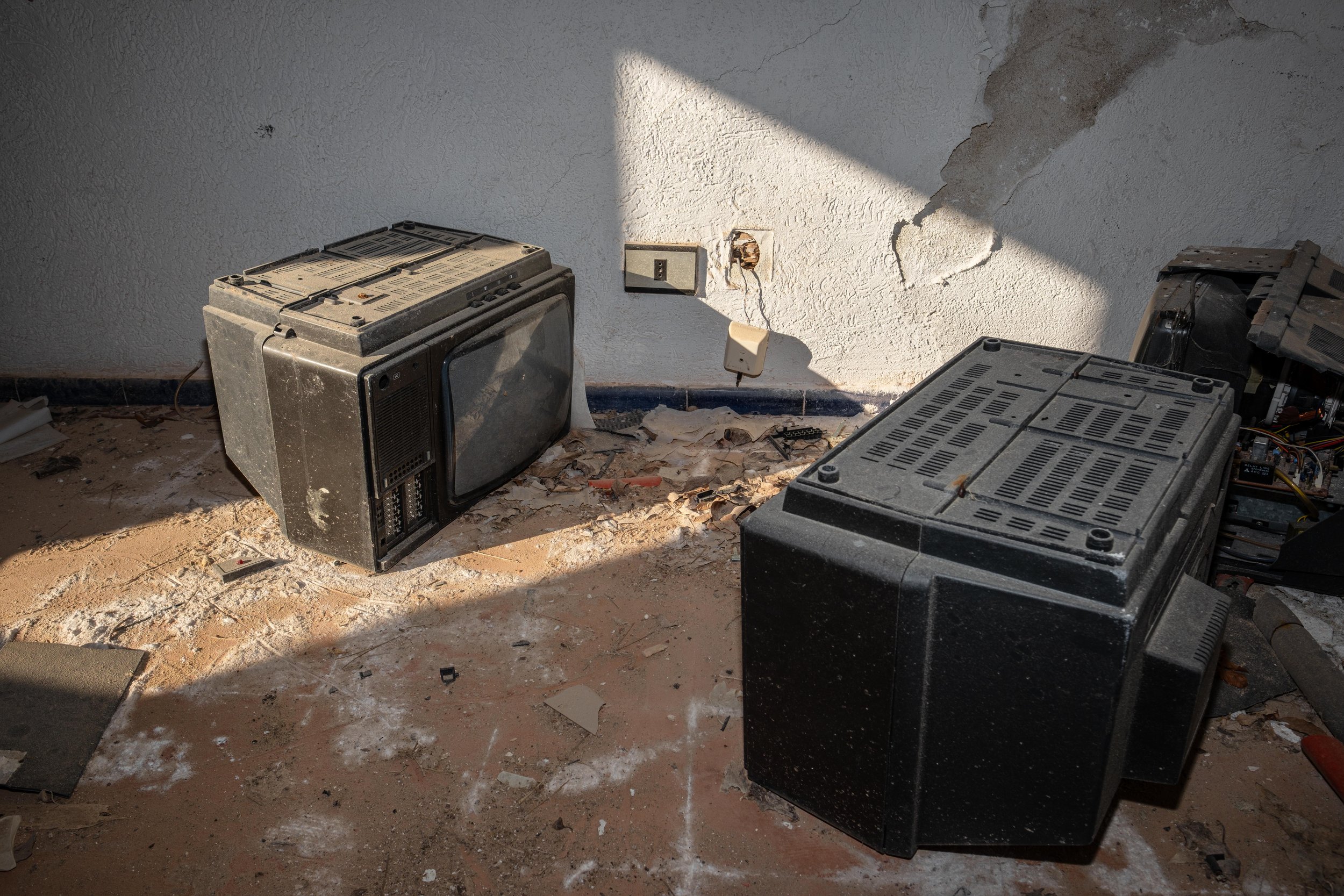
[If you've read this far and you're curious about sessions in places like this one, the Lost Places page is where to start.]One of the 250+ suites